 by
by Few contemporary actors have influenced modern Indian fashion as seamlessly as Alia Bhatt. From her early, girl-next-door aesthetic to her present status as a global fashion voice, Alia’s style journey mirrors the evolution of a generation that balances modernity with tradition. In a recent conversation with Vogue as part of its Life in Looks series, the actor offered rare insight into one garment that has remained a constant through her transformation—the saree.
Calling the saree “India’s little black dress,” Alia highlighted not just its elegance, but its comfort, adaptability, and emotional resonance. Through behind-the-scenes stories from her films, wedding, and public appearances, she explained why the six-yard drape continues to define her personal and professional identity.
Her reflections go beyond fashion trends, revealing how sarees function as cultural memory, storytelling tools, and expressions of selfhood—especially for women navigating visibility, confidence, and tradition in a modern world.
The Saree as India’s Little Black Dress
When Alia Bhatt likened the saree to the iconic little black dress (LBD), she wasn’t simply making a stylistic comparison—she was redefining how Indian fashion is perceived. Much like the LBD in Western wardrobes, the saree, she explained, fits nearly every occasion, body type, and mood.
“The saree in India is our little black dress,” Alia said. “It’s really comfortable. It suits every occasion, and when you give it pop, and you give it colour, it becomes super fun.”
This statement challenges the long-held notion that sarees are formal, restrictive, or reserved only for ceremonial moments. Instead, Alia positions the saree as democratic—something that can be worn casually, styled experimentally, and reimagined endlessly.
From cotton drapes worn on film sets to silk sarees gracing red carpets, Alia’s wardrobe demonstrates how the saree adapts without losing its soul.
Comfort as the New Luxury
One of the most striking aspects of Alia Bhatt’s fashion philosophy is her emphasis on comfort. In an industry often associated with rigid silhouettes and performative glamour, Alia consistently prioritizes ease and authenticity.
“I feel so comfortable and so myself in a saree,” she reiterated during the interview.
This sentiment reflects a broader shift in fashion—where luxury is no longer defined by heaviness or complexity, but by how a garment makes the wearer feel. Alia’s preference for breathable fabrics, soft hues, and effortless drapes underscores this evolution.
For her, comfort isn’t casual—it’s empowering. It allows freedom of movement, confidence in posture, and emotional ease, which ultimately enhances presence on screen and off.
Sarees as Storytelling Tools in Cinema
One of Alia Bhatt’s most impactful saree moments came through her portrayal of Rani Chatterjee in Rocky Aur Rani Kii Prem Kahaani. The character’s wardrobe became a visual language—expressing confidence, cultural pride, vulnerability, and emotional transformation.
“The sarees were worn so much in the film,” Alia recalled, explaining how deeply they were woven into the character’s identity.
Each saree Rani wore served a narrative purpose—bright colours symbolized strength and self-expression, while softer drapes mirrored emotional intimacy. The styling balanced tradition with modernity, making the character relatable to younger audiences while honoring Bengali aesthetics.
The response was overwhelming.
When On-Screen Fashion Becomes a Cultural Phenomenon
Perhaps the most fascinating behind-the-scenes revelation was how Rani’s sarees transcended the film and entered popular culture. Inspired by the audience’s reaction, the team created a capsule saree collection during the film’s promotions.
“We did like an online sale, and you know that money went to charity,” Alia shared. “And it crashed the website. It sold out in three and a half minutes.”
The rapid sell-out wasn’t just about celebrity endorsement—it reflected a renewed desire for accessible, contemporary sarees that felt aspirational yet wearable.
More importantly, the proceeds went to charity, reinforcing Alia’s belief that fashion can be both beautiful and purposeful.
Redefining Bridal Fashion: Alia Bhatt’s Wedding Saree
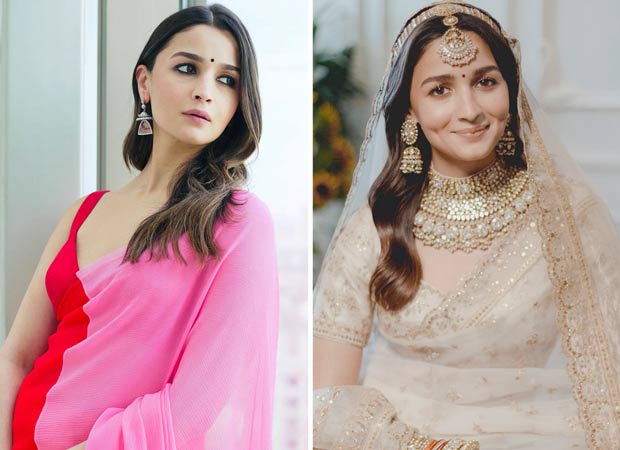
Among Alia Bhatt’s most iconic saree moments is her wedding look—a Sabyasachi Mukherjee creation that quietly rewrote the rules of bridal fashion.
Instead of opting for a heavily embroidered red lehenga, Alia chose a white organza saree with gold detailing—subtle, romantic, and deeply personal.
“I had asked Sabyasachi to make me something that was very comfortable and very me,” she revealed.
Sabyasachi suggested a “chai-dipped” white saree—a poetic description that perfectly captured the warmth and softness of the look. Paired with statement jewellery including a choker, earrings, a mang teeka, and minimal makeup, the ensemble became instantly iconic.
The look resonated globally, inspiring countless brides to prioritize individuality over tradition-bound expectations.
Why That Wedding Look Worked
The success of Alia’s wedding saree wasn’t just aesthetic—it was emotional. The outfit reflected intimacy rather than spectacle, aligning perfectly with the private nature of the ceremony.
Fashion critics noted how the look felt timeless rather than trendy, ensuring it would age gracefully in photographs and memory alike.
In a culture where bridal attire often symbolizes societal expectations, Alia’s choice represented autonomy—proof that tradition can be honoured without being overwhelming.
Sarees as Expressions of Identity
For Alia Bhatt, sarees aren’t costumes—they are extensions of self. Whether attending award functions, film promotions, or personal milestones, she gravitates toward drapes that reflect her mood rather than external expectations.
This authenticity has helped her build credibility as a style icon. Instead of chasing trends, she interprets them through a lens of personal comfort and cultural rootedness.
Her approach resonates especially with young women navigating similar spaces—balancing modern aspirations with inherited traditions.
The Evolution of Alia Bhatt’s Style
From preppy dresses in her early career to sophisticated ethnic wear today, Alia’s fashion journey mirrors her personal growth.
In her early films, she often leaned toward youthful silhouettes—short dresses, pastel colours, and minimal accessories. As her roles matured, so did her style, embracing sarees as symbols of confidence and depth.
This evolution wasn’t abrupt—it was organic, reflecting lived experience rather than strategic reinvention.
Sarees in a Global Fashion Conversation
Alia Bhatt’s advocacy for sarees also plays an important role in globalizing Indian fashion. As an international brand ambassador and frequent presence at global events, her choices carry cultural significance.
By choosing sarees for high-profile appearances, Alia positions Indian textiles and craftsmanship on the world stage—not as exotic novelties, but as everyday elegance.
This visibility challenges stereotypes and encourages a more nuanced appreciation of Indian fashion globally.
The Emotional Memory Woven Into Sarees
One reason sarees endure across generations is their emotional weight. They are often inherited, gifted, or associated with milestones—weddings, festivals, achievements.
Alia’s reflections subtly acknowledge this emotional legacy. Her wedding saree, film costumes, and promotional looks aren’t isolated fashion moments—they become memory markers.
In this way, sarees function as living archives, holding stories long after trends fade.
Why Sarees Continue to Thrive in Modern India
Despite fast fashion and western silhouettes dominating urban wardrobes, sarees remain relevant because they evolve without erasing tradition.
Designers experiment with fabrics, drapes, and styling, while wearers reinterpret them based on lifestyle and comfort.
Alia Bhatt’s endorsement reinforces this adaptability, showing that sarees belong as much in contemporary wardrobes as in traditional ones.
A Garment That Grows With the Woman Who Wears It
What Alia Bhatt’s reflections ultimately reveal is that the saree is not a static symbol of tradition, but a garment that evolves alongside the woman who wears it. As her life has shifted—from a young actor finding her footing, to a performer of depth, to a bride and global cultural representative—so too has her relationship with the saree. It has adapted to her needs, moods, and milestones without ever demanding that she become someone else. In this adaptability lies the saree’s quiet power. It allows individuality within continuity, offering space for reinvention while honouring memory. Alia’s ease in the drape speaks to a larger truth: when clothing aligns with identity, it stops being costume and becomes comfort. In celebrating the saree, she is not just endorsing a fashion choice, but acknowledging a companion that has witnessed growth, vulnerability, and self-assurance—thread by thread, moment by moment.
Why the Saree Endures in a Changing World
In a time when fashion moves at unprecedented speed, the saree’s endurance may seem almost radical. Yet, as Alia Bhatt’s journey illustrates, its relevance lies precisely in its refusal to be rushed. The saree invites patience, presence, and intention—qualities increasingly rare in modern living. It asks the wearer to engage, to feel, to inhabit her body with awareness. This is perhaps why it continues to resonate across generations and geographies. Alia’s articulation of the saree as India’s little black dress reframes it not as an obligation of heritage, but as a choice of confidence. By wearing it with authenticity and ease, she reminds us that tradition thrives not through preservation alone, but through participation. As long as women continue to find themselves—comfortable, expressive, and empowered—within its folds, the saree will remain timeless, not because it belongs to the past, but because it belongs to lived experience.
A Timeless Garment, Reimagined
Through her words and choices, Alia Bhatt reframes the saree not as a relic of the past, but as a living, breathing garment—capable of reinvention without losing its soul.
Her belief that sarees are India’s little black dress captures this perfectly: timeless, versatile, comforting, and endlessly expressive.
In celebrating sarees, Alia celebrates something larger—a cultural continuity that evolves with each generation, carried forward by women who wear it not out of obligation, but out of love.