 by
by When legends leave, they do not merely exit the world—they leave an echo. The passing of Dharmendra, one of the greatest icons of Indian cinema, has created such an echo: silent yet immense, heavy yet dignified. On November 24, at the age of 89, Dharmendra breathed his last—leaving behind not just a celebrated film legacy but also millions of hearts deeply touched by his warmth, humility, and humanity.
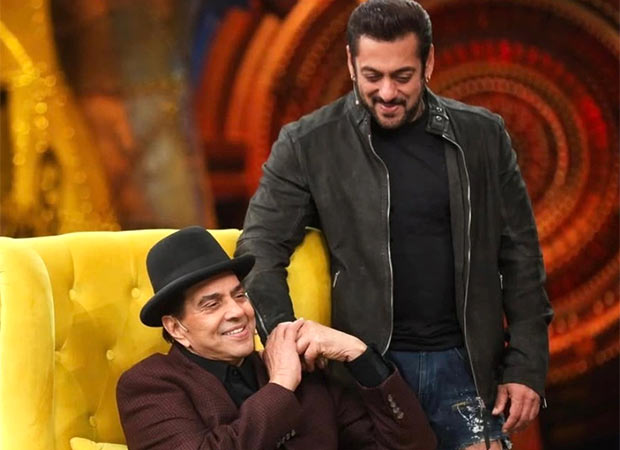
Among the many who mourned his loss was Salman Khan, one of Bollywood’s biggest and most iconic contemporary stars. While hosting Bigg Boss 19, Salman Khan became emotional as he addressed the nation and recalled Dharmendra’s passing. He called it a “huge loss” and confessed he wished he were not hosting the show during such a difficult time—but concluded with the hauntingly simple yet deep message:
“Life goes on.”
These three words did not just signify acceptance—they hinted at pain, memories, admiration, and an inner dialogue of grief. Salman Khan’s tribute did not merely feel like a host on a television show speaking—it felt like a son remembering a father, a disciple remembering a teacher, a friend remembering a friend.
This article explores the remarkable bond between Salman Khan and Dharmendra, their shared cinematic journey, their family’s decades-long association, and why Dharmendra’s loss feels like the closing of an entire chapter in Bollywood’s glorious history.
The Day Bollywood Fell Silent
On November 24, when the news of Dharmendra’s demise broke, social media, film studios, and homes across the country felt the weight of the moment. The “He-Man of Bollywood”—as he was widely known—had passed on after facing age-related health complications. Although his age had slowed his pace, his eyes never lost their charm, and his spirit never lost its vigour.
Salman Khan was among the very first to arrive at the crematorium, silently walking past the cameras, avoiding attention or statements. Later, he attended the prayer meet organized by the Deol family on November 27, paying his respects once again. This wasn’t a formal appearance; this was personal. This was Salman saying goodbye to someone who had guided, encouraged, and inspired him throughout his journey.
“This Week Was a Huge Loss” — Salman Khan on Bigg Boss 19
Hosting a popular television show amid personal grief is never easy. But Salman maintained composure, even though his voice carried the weight of sorrow. He said on the show:
“This week the industry faced a huge loss. I wish I were not hosting Bigg Boss this week, but at the end, life goes on.”
Those words resonated deeply with viewers, thousands of whom expressed condolences online not only for Dharmendra but also for Salman, who seemed visibly emotional. The remark became symbolic—not just of Bollywood moving forward, but of life itself, teaching us yet again that losses are inevitable, but memories live on.
A Bond Rooted in History — The Khan & Deol Connection
The Salman-Dharmendra bond didn’t start on a film set. It began decades ago, before Salman Khan made his debut, before the 90s era took off, even before commercial cinema changed its shape.
The connection began through Salim Khan, Salman’s father and one of Bollywood’s greatest screenwriters. Salim Khan, along with Javed Akhtar, wrote Sholay—the film that immortalized Dharmendra as Veeru, one of the most iconic characters in world cinema. To this day, Veeru remains a symbol of friendship, courage, loyalty, and emotional depth. The role defined Dharmendra’s charisma, and his chemistry with Amitabh Bachchan became the blueprint of cinematic bromance.
The Khan and Deol families developed mutual respect that transcended film projects. Salman, growing up amid actors and storytellers, naturally admired Dharmendra. He saw in him not just a star but a grounded, compassionate human being. Years later, when they finally worked together, that respect turned into a profound bond.
“Pyaar Kiya Toh Darna Kya” — A Collaboration That Strengthened Their Relationship
One of the most memorable collaborations between Salman Khan and Dharmendra was the 1998 film Pyaar Kiya Toh Darna Kya, which also starred Kajol and Arbaaz Khan. Dharmendra played the role of a protective uncle—strong, emotionally layered, and unforgettable. The film wasn’t just a commercial success—it became a significant emotional milestone for Salman Khan.
Behind the scenes, the bond grew. Dharmendra reportedly praised Salman’s discipline and screen presence, while Salman often referred to Dharmendra as “Dharamji”—a term of respect that emerged from genuine admiration.
Fans and crew members recall that Salman looked at Dharmendra with a student’s eyes—always eager to learn, always listening carefully to his advice. People present on set often say that Dharmendra treated Salman like family—not like just another co-star. That warmth continued even after the film was over.
Salman Khan on Dharmendra — More Than Just Respect
Salman Khan has never been shy about expressing what Dharmendra meant to him. On various occasions, he mentioned:
- Dharmendra was a role model, both for his career and his character.
- The Deol family was like extended family to the Khans.
- Dharmendra’s simplicity inspired him — despite being a superstar, Dharmendra always remained humble.
- He admired Dharmendra’s integrity — both in cinema and real life.
- He considered Dharmendra a mentor-figure — especially during tough phases in his career.
This wasn’t just a professional equation; it felt deeply emotional. Salman often said that greatness is not only defined by talent—but by attitude. Dharmendra embodied this truth.
Why “Life Goes On” Felt So Powerful
Salman’s phrase “Life goes on” became a trending line on social media, not only because of the grief attached to it—but also because of its philosophical depth.
In Indian culture, especially among artists, these words hold meaning beyond acceptance—they symbolize resilience. Bollywood has lost giants before—Rajesh Khanna, Dilip Kumar, Sridevi, Irrfan Khan, Rishi Kapoor, and now Dharmendra. Yet cinema continues. Films continue. Stories continue.
Dharmendra himself believed in this philosophy. He once said:
“Actors may retire, but emotions never do. Cinema must go on because people need dreams.”
These words mirror Salman’s tribute. It’s as though Dharmendra’s spirit was speaking through him that night. “Life goes on”—not because we forget—but because we move forward carrying their stories within us.
Dharmendra: The Man Behind the Legend
To understand the impact of this loss, one must understand the man Dharmendra truly was.
Born as Dharmendra Deol on December 8, 1935, in Punjab, he came from humble beginnings. He wasn’t born into fame; he earned it—through perseverance, raw talent, and sheer passion for cinema.
Early interviews show him speaking shyly about his struggles, saying:
“I didn’t come to Bombay with dreams of stardom. I just wanted to work hard and support my family.”
He struggled, faced rejection, overcame insecurities, and strived every day until finally — his screen presence was noticed, his voice was recognized, and his charm became legendary.
Why India Loved Dharmendra
Dharmendra wasn’t just admired for his looks—he was celebrated for his authenticity. He was charismatic without arrogance, handsome without vanity, tough without aggression. He embodied the ‘everyman hero’—a man audiences could relate to.
From romantic roles to action-packed dramas, Dharmendra built a career spanning six decades. He was not a product of stardom; he was its architect.
Legacy of Films: From Sholay to Pyaar Kiya Toh Darna Kya
Dharmendra’s filmography is not merely a career—it is an era. With 300+ films, he was not just prolific—he was unforgettable.
Some of his most iconic roles include:
- Veeru in Sholay (1975)
- Phool Aur Patthar (1966)
- Satyakam (1969) — one of his finest performances
- Seeta Aur Geeta (1972)
- Chupke Chupke (1975) — his comic brilliance
- Shalimar (1978)
- Pyaar Kiya Toh Darna Kya (1998)
The last film listed remains particularly important—not just cinematically but emotionally—for the bond it deepened between Salman and Dharmendra.
Generations Inspired — The End of an Era
Dharmendra’s death feels symbolic—a closure to a golden era of Indian cinema where simplicity met sincerity. Glamour did not overshadow grace. Stardom did not overpower humility. That era shaped Bollywood’s foundation, and Dharmendra was one of its strongest pillars.
For Salman Khan, Dharmendra was a bridge between old-school inspiration and new-age cinema. Salman always believed that no matter how big a star becomes, one must carry their roots with pride—and Dharmendra was a living example of this principle.
Salman Khan’s Grief: A Reflection of Bollywood’s Heart
In Salman’s emotional response, one could sense a wider loss—the grief of the entire film fraternity. Bigg Boss 19 had countless viewers, but that moment felt intimate—like millions silently mourning.
Fans began sharing clips from Pyaar Kiya Toh Darna Kya, photos from their events, and vintage interviews of them together. Many wrote messages such as:
- “Salman looked like he lost someone from his own family.”
- “When Salman said life goes on—it felt like he said it for all of us.”
- “Dharmendra didn’t act; he lived cinema.”
The nation didn’t just witness a tribute—they felt it.
The Human Behind the Star — Dharmendra’s Values and Wisdom
Dharmendra was respected not only for acting but for his approach toward life. He believed:
- Fame is temporary; character is permanent.
- Success means nothing without kindness.
- Talent alone does not make a star — humility does.
- Cinema should touch hearts, not just impress critics.
This belief system is what inspired stars like Salman, Shah Rukh Khan, Akshay Kumar, Ajay Devgn, and many more. Dharmendra was a living masterclass—teaching values without preaching them.
Dharmendra and the Khan Era — A Loop Completed
There is poetic symmetry in the fact that Salman Khan—one of the kings of modern-day Bollywood—paid tribute to Dharmendra—the king of an earlier generation.
One represented the golden age of Bollywood; the other represents the commercial modern era. Dharmendra paved the way for the kind of stardom Salman built upon. Their connection feels symbolic, cinematic, and deeply emotional—almost like a baton being passed across time.
“He Was Like Family”—Salman’s Personal Loss
In private conversations, Salman always referred to Dharmendra with warmth and a quiet pride. He mentioned on various occasions that Dharmendra’s strength and simplicity shaped his idea of stardom.
In many ways, Salman mirrors Dharmendra’s persona—a combination of tough exterior and emotional sensitivity. People close to Salman reveal that Dharmendra was among the few industry seniors he admired without hesitation.
Their last meeting was said to be warm, heartfelt, and full of nostalgia. Dharmendra reportedly told Salman:
“Keep making the audience smile. That’s the only duty of an actor.”
This advice now remains etched in Salman’s heart—and perhaps guides his future choices more than we know.
A Nation Mourns, A Legacy Lives On
Even in death, Dharmendra remains alive — through memories, films, and the hearts he touched. He symbolized an era that celebrated strength and softness at the same time. A man who could be fierce in action scenes yet gentle in emotional moments—without losing authenticity.
His passing is not an end. It is a transformation — of his energy, his legacy, and his teachings into cinematic eternity.
Final Thoughts — Pain, Pride & Continuity
In the end, Salman Khan’s words echo not just a personal tribute, but a universal truth.
“Life goes on.”
But these words are not meant to dismiss grief—they are meant to honour it. Life goes on because Dharmendra would want it to. His legacy of hard work would want the industry to keep moving forward. His love for cinema would want new stories to be told. His spirit would want acting to remain honest, humble, and human.
Dharmendra may have left the stage,
but the lights he lit will never go out.
He may no longer be seen on screen,
but his presence will be felt every time the camera rolls.
And in every corner of Indian cinema…
Veeru will live on.