 by
by Rakul Preet Singh has steadily established herself as one of Bollywood’s most versatile actresses, seamlessly balancing commercial appeal with nuanced performances. Her work in De De Pyaar De 2 exemplifies this duality, combining her effortless acting with a fashion sensibility that enhances her characters rather than overshadows them. In the film, she steps into the role of Ayesha, a character whose journey is rooted in emotional depth, everyday relatability, and evolving self-awareness. What sets Rakul apart in this film is how her wardrobe choices are intentionally woven into the narrative fabric, allowing the fashion to feel organic, functional, and emotionally resonant.
Unlike conventional Bollywood films that often rely on overt glamour to define female characters, De De Pyaar De 2 takes a subtler approach. Ayesha’s wardrobe blends contemporary aesthetics with narrative relevance, evolving naturally as the story unfolds. From energetic musical numbers to intimate domestic moments, Rakul’s costumes communicate not just her style but also her character’s personality, state of mind, and emotional trajectory. Each outfit is carefully chosen to reflect Ayesha’s modernity, independence, and emotional sensitivity, illustrating that fashion in film can be both beautiful and narratively purposeful.
Subtlety Meets Celebration: Rakul’s Pink Saree in the ‘Jhoom Sharaabi’ Song
One of the standout sartorial moments in De De Pyaar De 2 is Rakul’s pink Fendy silk saree during the “Jhoom Sharaabi” sequence. The song, celebratory in tone, required a look that was festive yet grounded. The soft sheen of the silk, coupled with delicate stone embellishments, adds a layer of sophistication while keeping the focus on the performance. The fluid drape of the saree moves gracefully with her dance, enhancing the visual rhythm without overshadowing the music or choreography.
What makes this saree remarkable is the way it strikes a balance between traditional elegance and modern styling. The subtle shimmer reflects festive joy, while the choice of fabric and minimalistic embellishments ensures that it does not feel overdone. This moment is a prime example of how Rakul’s wardrobe choices complement her character’s personality—celebratory, vibrant, and contemporary—without slipping into ostentation. For audiences, it reaffirms that style in Bollywood can be both narrative-driven and visually striking.
Ice Blue Ombre Lehenga: Visual Poetry in Motion
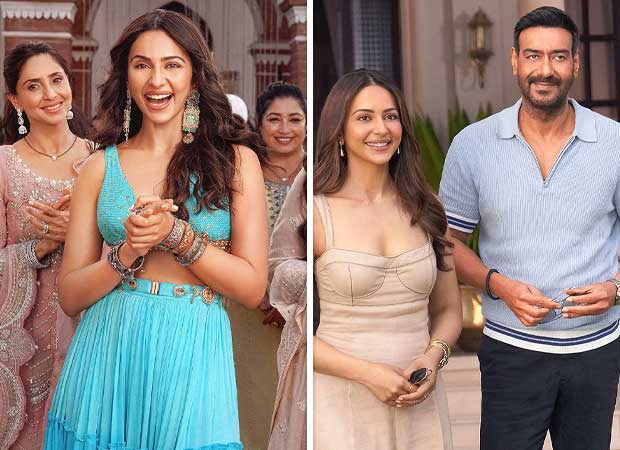
In a key celebratory dance sequence, Rakul dons an ice blue ombre lehenga that captures the energy and excitement of the moment. The gradient hues of the lehenga, shifting delicately from icy tones to deeper shades, create a visual spectacle that enhances the scene’s aesthetic without dominating it. The subtle shimmer in the fabric interacts beautifully with the lighting and camera movements, ensuring that the outfit remains dynamic yet complementary to the narrative.
The layered silhouette of the lehenga adds dimension and movement, allowing Rakul to dance effortlessly while maintaining elegance. This outfit exemplifies how costume design can contribute to storytelling: the visual elements reinforce the celebratory mood while reflecting Ayesha’s personality—joyful, confident, and lively. By blending intricate design with practical wearability, the costume designers and Rakul herself demonstrate that Bollywood fashion need not be extravagant to leave a lasting impression.
Bridal Lehenga in the ‘Baabul Ve’ Emotional Sequence
De De Pyaar De 2 also explores deeply emotional territory, and Rakul’s wardrobe choices in these moments underscore the narrative gravity. During the “Baabul Ve” sequence, she wears a bridal lehenga that is richly embroidered, traditional yet understated in its execution. This look is not merely about aesthetics; it serves as a visual metaphor for familial bonds, emotional vulnerability, and the sanctity of personal milestones.
The lehenga’s classic silhouette reinforces the cultural weight of the father-daughter relationship explored in the scene. Every stitch, embellishment, and design choice communicates respect for tradition while highlighting Ayesha’s personal journey. The outfit’s ability to convey emotion without dialogue exemplifies how Rakul’s fashion in the film is intentionally story-driven. For viewers, the bridal lehenga becomes more than clothing—it is a narrative tool that amplifies the scene’s emotional resonance.
Casual Chic: Blush Tones for Everyday Relatability
Not all of Ayesha’s wardrobe moments are extravagant; some of the most impactful looks are understated, such as her blush cropped top paired with relaxed joggers. The ribbed texture, button detailing, and soft fabric communicate realism, reflecting Ayesha’s independent, contemporary lifestyle. These casual chic outfits reinforce her relatability and modern sensibility, reminding audiences that fashion in film can be functional and aspirational simultaneously.
Such looks are critical because they humanize the character. While sarees and lehengas capture the celebratory and formal moments, casual outfits anchor Ayesha in everyday life. They make her approachable, allowing audiences to see themselves in her experiences. By styling these moments with thoughtfulness and precision, Rakul and the costume team ensure that fashion enhances the story rather than distracting from it.
Beige Corset-Style Dress: Structured Elegance
In another visually compelling sequence, Rakul wears a beige corset-style dress featuring structured seam detailing and a square neckline. The dress exemplifies refined modernity and minimalism, perfectly suited to the scene’s tone. Styled minimally, the outfit maintains elegance while fitting seamlessly into the film’s visual and emotional framework.
This look demonstrates how subtle tailoring can elevate character portrayal. The corset structure conveys confidence and poise, reflecting Ayesha’s inner strength. Simultaneously, the neutral tone and understated styling prevent the costume from overshadowing the scene’s emotional core. Through choices like these, Rakul Preet Singh proves that style in cinema can be both sophisticated and narratively intentional.
Soft Sophistication: Yellow Off-Shoulder Knit
In a quieter, more intimate scene, Rakul wears a yellow off-shoulder knit that communicates warmth and accessibility. The muted color palette and fluid fit reflect emotional softness while aligning with contemporary fashion sensibilities. This ensemble demonstrates how even simple, minimalistic outfits can evoke mood, character depth, and visual coherence within a film.
The yellow knit, combined with natural styling and understated accessories, complements Ayesha’s personality, emphasizing her emotional availability and approachability. Scenes like these highlight the importance of costume design in creating a believable, multidimensional character. By pairing aesthetics with story relevance, Rakul Preet Singh’s wardrobe choices contribute meaningfully to audience immersion.
Storytelling Through Fashion: The Subtle Power of Character-Driven Styling
Rakul Preet Singh’s fashion in De De Pyaar De 2 exemplifies the principle that style can serve the narrative rather than exist solely for spectacle. Each outfit is carefully curated to reflect Ayesha’s emotional state, social context, and personal evolution, creating a seamless integration of wardrobe and storytelling. From vibrant sarees and lehengas to relaxed, everyday wear, the costumes enhance character development, adding visual depth without distraction.
This approach challenges conventional Bollywood norms where glamour often overshadows narrative. Instead, De De Pyaar De 2 demonstrates how subtle, functional, and story-driven fashion can amplify a character’s relatability and emotional resonance. By embracing this philosophy, Rakul Preet Singh and the costume team elevate Ayesha’s wardrobe from mere aesthetics to an essential storytelling device.
The Role of Color in Character Expression
Color plays a pivotal role in defining Ayesha’s journey. Bright pinks, icy blues, and warm yellows are strategically used to reflect her mood, milestones, and personal growth. The pink saree in “Jhoom Sharaabi” conveys celebration and joy, the ice blue lehenga signals festivity with modern elegance, and the yellow knit evokes emotional warmth and intimacy. These choices demonstrate how wardrobe color can act as a visual shorthand for character emotion, providing subtle cues that enhance narrative comprehension.
Moreover, the progression of color palettes throughout the film mirrors Ayesha’s personal evolution. From playful and vibrant to understated and reflective, each look is thoughtfully calibrated to reinforce the storytelling arc. Through this visual language, Rakul Preet Singh’s wardrobe contributes to a richer, more immersive audience experience.
Balancing Modernity and Tradition
Ayesha’s style in De De Pyaar De 2 strikes a delicate balance between contemporary trends and cultural authenticity. Sarees and lehengas honor tradition while incorporating modern cuts, textures, and draping techniques. Casual and semi-formal outfits reflect contemporary fashion sensibilities, resonating with audiences who seek both relatability and aspiration.
This balance underscores the broader evolution of fashion in Bollywood cinema. Characters are no longer defined solely by grandeur or glamour; instead, their wardrobe choices communicate personality, lifestyle, and emotional nuance. Rakul Preet Singh’s performance illustrates how thoughtful styling can merge modernity with tradition, creating a character that is both aspirational and authentic.
Functional Fashion: Movement and Realism
Beyond aesthetics, functionality is a key consideration in Ayesha’s wardrobe. Dance sequences, emotional confrontations, and intimate moments demand outfits that allow natural movement and expression. From flowing lehengas to relaxed joggers, the costumes accommodate physicality while maintaining visual appeal. This practical consideration enhances the realism of Ayesha’s portrayal, ensuring that wardrobe supports rather than inhibits performance.
Functional fashion also contributes to audience immersion. When characters move naturally within their environment, aided by well-designed costumes, viewers are better able to connect with their journey. Rakul Preet Singh’s ability to inhabit these outfits with ease reinforces the believability and relatability of Ayesha’s character.
Minimal Accessories, Maximum Impact
Another defining feature of Ayesha’s wardrobe is its minimalism in accessorization. Rather than relying on heavy jewelry or flashy embellishments, the looks often employ subtle accents that complement the outfit and the scene’s emotional tone. This approach ensures that attention remains on Ayesha’s performance while still allowing fashion to communicate personality and style.
Minimal accessories align with the film’s broader aesthetic philosophy: understated elegance, emotional coherence, and narrative-driven design. By employing restraint, the wardrobe maintains visual balance and supports the storytelling, demonstrating that impactful fashion does not require excess.
Audience Reception and Influence
Audiences have responded enthusiastically to Rakul Preet Singh’s fashion in De De Pyaar De 2. Social media buzz, fan recreations, and media coverage highlight how her wardrobe has inspired viewers, offering ideas for blending contemporary style with emotional authenticity. Fans appreciate that the looks are not just glamorous but attainable and meaningful, reinforcing the idea that Bollywood fashion can influence everyday style choices.
The positive reception underscores the power of character-driven styling. By aligning wardrobe with narrative and personality, Rakul Preet Singh’s fashion choices create a lasting impression, extending the influence of her performance beyond the screen. Audiences are not merely observers but participants, interpreting and emulating the style in ways that reinforce engagement with the film and its themes.
Rakul Preet Singh: A Style Icon for Modern Cinema
Through De De Pyaar De 2, Rakul Preet Singh demonstrates that fashion can be subtle, strong, and story-driven. Her wardrobe choices are thoughtful, functional, and emotionally resonant, supporting her performance while contributing to audience immersion. By blending contemporary aesthetics with narrative relevance, she proves that style in modern Bollywood cinema need not be superficial—it can be an extension of character, mood, and storytelling.
Rakul’s ability to balance glamour, realism, and narrative cohesion establishes her as a style icon whose influence transcends cinematic moments. She embodies the evolving ethos of Bollywood fashion: thoughtful, purposeful, and aligned with character-driven storytelling. Her work in this film serves as a model for how wardrobe can enrich performance, enhance narrative impact, and inspire audiences in subtle yet meaningful ways.
Conclusion: Storytelling Through Style
In De De Pyaar De 2, Rakul Preet Singh exemplifies how fashion can be more than decoration—it can be a tool for storytelling. Each outfit, from celebratory sarees and ombre lehengas to casual chic ensembles, communicates personality, emotion, and context. The wardrobe supports the narrative, complements the performance, and enhances audience engagement, demonstrating the subtle power of well-curated fashion in cinema.
By embracing style that is functional, emotionally resonant, and visually cohesive, Rakul Preet Singh elevates Ayesha’s character beyond mere appearance. The film offers a blueprint for integrating wardrobe into storytelling, highlighting the symbiotic relationship between performance and fashion. Ultimately, Rakul’s looks in De De Pyaar De 2 prove that subtlety, strength, and story-driven design can coexist beautifully, reinforcing her position as one of Bollywood’s most influential and style-conscious actors.