 by
by When it comes to fashion that disrupts expectations, few public figures in India command attention quite like Uorfi Javed. Over the years, she has transformed her wardrobe into a laboratory of visual experimentation — crafting outfits from unconventional materials, dismantling the idea of “wearable” clothing, and repeatedly challenging the thin line between shock value and conceptual art.
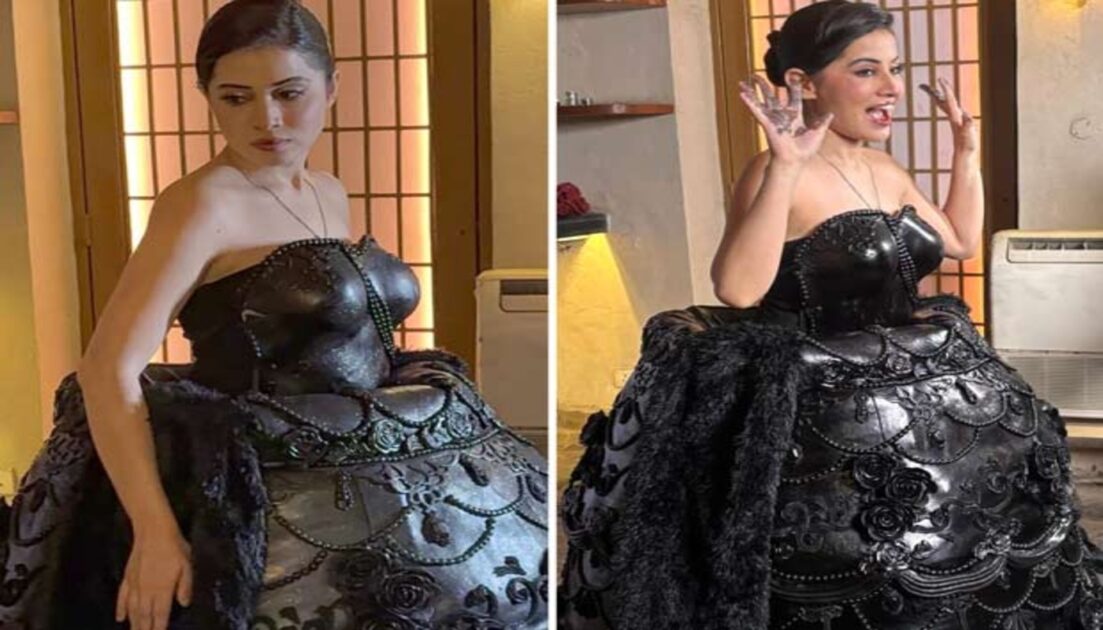
But her latest creation — a 100-kilogram dark chocolate cake dress — may be her most audacious statement yet. In an exclusive interaction, she revealed that the look was not conceived merely as an outfit, but as an immersive art concept. “I didn’t just want to wear a cake,” she explained. “I wanted to become the cake — like a walking, edible art installation.”
The phrase itself captures the ambition behind the project. This wasn’t a novelty costume. It was couture reimagined through the lens of sculpture, engineering, food science, and performance art. It was fashion as spectacle — and spectacle as philosophy.
The Dream That Refused to Melt
According to Uorfi, the idea of creating an outfit made entirely out of cake had lived in her imagination for years. She once saw an image online of someone wearing something similar, and the visual lingered. It wasn’t simply admiration — it was a creative itch.
Why hasn’t this been done in India in a truly large-scale way?
Why can’t fashion be edible?
Why can’t the body itself become dessert?
For Uorfi, those questions weren’t rhetorical. They were challenges.
Fashion, for her, is about pushing boundaries until they blur. She thrives on creating looks that provoke conversation, debate, and sometimes disbelief. If something feels impossible or absurd, that’s often where her interest peaks. The cake dress wasn’t just a whimsical fantasy — it was a calculated decision to stretch the imagination of what clothing can be.
In many ways, this is consistent with her creative journey. She has long used garments as storytelling tools — transforming safety pins, wires, fabric scraps, and found materials into dramatic silhouettes. The cake dress represents the next evolution of that philosophy: the fusion of culinary art and couture.
Couture Meets Confectionery
Transforming the vision into reality required far more than frosting and enthusiasm. The creation process was methodical, highly technical, and layered — quite literally.
The planning stage alone took days. The team had to answer a fundamental question: how do you make something edible structurally wearable?
Cake, by nature, is soft, fragile, and designed to be consumed — not strapped to a human body under studio lights. Traditional fashion materials offer flexibility, support, and durability. Cake offers none of these.
To solve the problem, the design team approached the outfit as an architectural structure rather than a garment. A strong foam base was constructed to serve as the skeletal support system. This foundation ensured that the dress would not collapse under its own weight. The edible portion — nearly five kilograms of actual cake — was integrated strategically into the design to maintain freshness and minimize waste.
The layering of the cake was done within a strict 24-hour window before the shoot to ensure quality and texture. Temperature control became critical. The dress had to be kept in an air-conditioned environment at all times. During transportation, it traveled in an AC van. At the shoot location, coolers were placed below the outfit to preserve stability.
What emerged was less a dress and more a hybrid object — part sculpture, part dessert, part costume.
Engineering the Impossible
Perhaps the most fascinating dimension of the cake dress lies in its engineering logic. Fashion design rarely intersects with structural physics and food preservation, but here they were inseparable.
The foam base acted like the internal scaffolding of a building. It provided stability while allowing for the illusion of a fully edible silhouette. The cake layers had to be thick enough to appear substantial yet light enough to avoid cracking. The balance between density and delicacy became a science.
Every movement required caution. Unlike fabric, cake cannot flex naturally with the body. It does not forgive sudden gestures. It does not respond well to heat or friction. Even standing still demands careful distribution of weight.
In essence, Uorfi had to become part of the structure. Her posture, balance, and timing were all integrated into the garment’s survival.
This is where fashion transitioned into performance art. Wearing the cake was not passive. It required participation.
A Walking Dessert as Artistic Statement
The idea of a “walking, edible art installation” carries deeper cultural symbolism than it might initially suggest. Historically, art installations are meant to be immersive, experiential, and sometimes ephemeral. They exist to provoke reaction — to disrupt passive viewing.
By turning herself into the installation, Uorfi blurred the boundaries between model and medium. The body became canvas. The garment became sculpture. The audience became participant.
The concept also touches on consumption — not just of food, but of fashion and celebrity culture. In a digital age where outfits are devoured by social media within seconds, creating a literal edible dress becomes a playful metaphor.
You can wear your dessert.
You can consume the spectacle.
You can turn fashion into something both transient and tangible.
The cake dress lives in this paradox — edible yet untouchable, fragile yet engineered, absurd yet meticulously calculated.
The Challenge of Softness
The biggest obstacle was maintaining structural integrity while preserving the cake’s softness. Cake is inherently unstable. It absorbs moisture, responds to temperature changes, and deforms under pressure.
The team had to carefully layer the edible portion so it would not sag or lose shape. Air-conditioning became non-negotiable. Even small temperature fluctuations could alter texture.
Handling the dress required the care usually reserved for high-end patisserie creations. It wasn’t just styled; it was preserved.
In that sense, the garment existed on borrowed time. Its lifespan was temporary. Unlike traditional couture that can be archived, this piece was ephemeral — a fleeting masterpiece designed for a moment.
There’s poetic beauty in that impermanence.
Fashion as Provocation
Uorfi has never shied away from controversy. Her designs often spark debate — some viewers see innovation; others see spectacle.
The cake dress sits squarely within that tension.
On one hand, it is playful and whimsical. On the other, it challenges entrenched ideas about what constitutes “serious” fashion. Critics may dismiss it as gimmicky, but the level of planning, craftsmanship, and cross-disciplinary coordination suggests otherwise.
Fashion history is filled with moments that were initially mocked but later celebrated as groundbreaking. From unconventional materials on global runways to conceptual pieces that defy practicality, the evolution of style depends on those willing to experiment.
The cake dress fits into that lineage of experimentation. It may not be wearable in everyday life — but it was never meant to be.
The Cultural Context of Edible Fashion
Food and fashion share surprising parallels. Both are sensory experiences. Both involve texture, color, and presentation. Both can communicate identity and creativity.
By merging the two, Uorfi tapped into a broader artistic tradition where boundaries dissolve. Designers internationally have used chocolate, sugar, and even meat in garments to make statements about consumption, desire, and excess.
What makes this experiment distinctive in the Indian context is its scale and theatricality. A 100-kilogram chocolate creation is not subtle. It demands attention.
It also resonates with India’s love for elaborate desserts and grand celebrations. Cakes are central to milestones — birthdays, weddings, achievements. Turning one into couture amplifies that celebratory symbolism.
The Social Media Effect
In today’s digital ecosystem, visual impact is currency. The cake dress was engineered not only for structural viability but also for visual drama.
Dark chocolate tones, sculpted layers, and frosting details created a rich aesthetic contrast against studio lighting. The silhouette had to read clearly on camera while maintaining illusion up close.
Social media thrives on the extraordinary. An outfit that merges dessert and couture is instantly shareable. It disrupts scrolling patterns. It invites commentary.
But beyond virality lies intention. Uorfi’s philosophy remains consistent: if it hasn’t been done before, it’s worth attempting.
Engineering + Baking + Couture
Perhaps the most compelling aspect of the cake dress is how it required collaboration across disciplines. This was not simply a designer and a stylist assembling fabric. It involved bakers, structural planners, stylists, and logistical coordinators.
The edible portion required culinary precision. The foam framework required design intelligence. The final styling required aesthetic coherence.
This convergence of skill sets transforms the project from fashion stunt to creative experiment.
In a world where industries increasingly overlap, such collaborations reflect the future of artistic expression — where boundaries between craft forms are porous.
The Emotional Core
Behind the spectacle lies a deeply personal drive. Uorfi’s desire to “become the cake” reveals something about her relationship with fashion.
She doesn’t just wear clothes. She inhabits concepts.
For her, garments are not coverings; they are narratives. The cake dress was an embodiment of whimsy, risk-taking, and refusal to conform.
It also reflects vulnerability. Wearing something that could crumble or melt carries symbolic weight. It exposes fragility while celebrating boldness.
There is courage in presenting oneself as an edible sculpture — knowing it may be misunderstood.
The Broader Impact
Will cake dresses become mainstream couture? Unlikely.
But that isn’t the goal.
The true impact lies in expanding imagination. By demonstrating that fashion can integrate baking science and architectural planning, Uorfi broadens the horizon of what young designers might consider possible.
She proves that ideas that seem absurd at first glance can materialize with enough persistence and ingenuity.
And in doing so, she reaffirms a timeless creative truth: innovation begins where practicality ends.
A Statement Beyond Shock
It would be easy to categorize the cake dress as a shock tactic. But beneath the spectacle lies discipline — temperature control, structural planning, material balancing, timing precision.
This wasn’t chaos. It was calculated experimentation.
Uorfi’s statement, “If you can imagine it, you can create it,” encapsulates the ethos behind the project. The cake dress is a reminder that creativity thrives on risk.
Sometimes, that risk looks like frosting.
Conclusion: When Fashion Becomes Edible Art
The 100-kilogram dark chocolate cake dress stands as one of the boldest experiments in contemporary Indian celebrity fashion. It merges sculpture, dessert, engineering, and performance into a singular moment of spectacle.
More importantly, it transforms the body into art — not metaphorically, but literally.
By choosing to become the cake rather than merely wear it, Uorfi redefined the relationship between garment and wearer. She blurred the line between edible and wearable, fragile and formidable, absurd and ambitious.
In doing so, she didn’t just create an outfit.
She created a conversation.
And in the ever-evolving world of fashion, conversation is the ultimate currency.