 by
by Aamir Khan, Preity Zinta and Sunny Deol Join Amitabh Bachchan on KBC 18 Premiere: A Star-Studded Beginning to the New Season
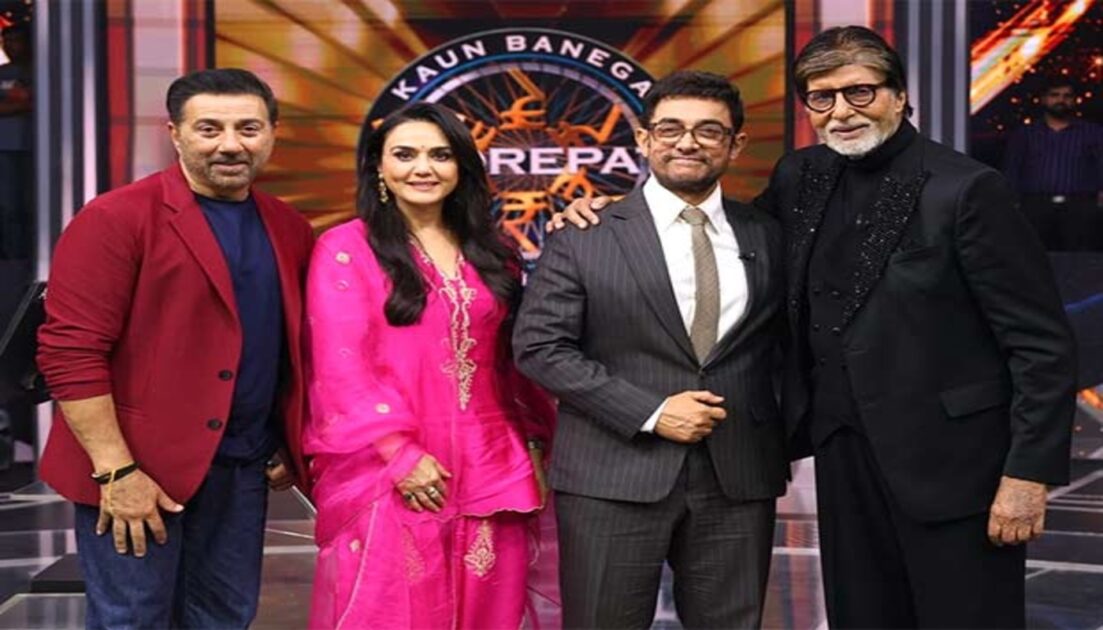
The 18th season of Kaun Banega Crorepati is set to begin with an unusually starry opening. Amitabh Bachchan, who has become inseparable from the identity of the iconic quiz show over the years, will welcome three major Bollywood names to the premiere episode: Aamir Khan, Preity Zinta and Sunny Deol. The trio will share the hot seat with Bachchan as they promote their upcoming period drama Batwara 1947, bringing together four generations-defining screen personalities for what promises to be one of the most anticipated television appearances of the season.
The appearance had earlier been reported as a possibility, with reports suggesting that the three actors would visit the show to promote their upcoming film. The development has now been confirmed, adding another layer of excitement to the launch of Kaun Banega Crorepati 18. The new season is scheduled to premiere on August 10, with the makers returning with a refreshed theme centred on thinking, reasoning and applying knowledge rather than simply relying on memorised information. (Bollywood Hungama)
The decision to begin the season with Aamir Khan, Preity Zinta and Sunny Deol is significant beyond the obvious star power. The three actors represent different eras, screen identities and audience relationships within Hindi cinema. Their collective appearance alongside Amitabh Bachchan also creates a rare meeting point between nostalgia, contemporary promotion and the emotional weight of a historical film.
At the centre of their visit is Batwara 1947, Rajkumar Santoshi’s upcoming period drama produced by Aamir Khan Productions. The film, which was previously known as Lahore 1947, is scheduled to arrive in cinemas on August 14, 2026, placing its release directly within the Independence Day weekend. (Bollywood Hungama)
KBC 18 Begins With a Major Bollywood Gathering
For nearly two decades, Kaun Banega Crorepati has occupied a distinctive place in Indian popular culture. Unlike conventional celebrity chat shows, the programme creates a different dynamic between stars and the host because celebrities are placed in the position of contestants. They have to answer questions, use lifelines, negotiate uncertainty and occasionally reveal a playful side of themselves that audiences may not always see in film promotions.
That format becomes particularly interesting when the guests are established stars themselves.
Aamir Khan, Preity Zinta and Sunny Deol have each cultivated highly recognisable public identities. Aamir has long been associated with selective projects and an image built around intense preparation and socially conscious storytelling. Preity Zinta carries enormous nostalgia from the late 1990s and 2000s while now returning to acting after an extended break. Sunny Deol, meanwhile, has experienced another major phase of audience interest following the resurgence of his cinematic popularity.
Putting these personalities together on the KBC hot seat creates the possibility of a promotional appearance that feels less like a conventional press interaction and more like a reunion of Bollywood eras.
The presence of Amitabh Bachchan makes that equation even more compelling.
Bachchan’s own relationship with Kaun Banega Crorepati is deeply connected to the show’s identity. His measured hosting style, characteristic pauses and ability to move seamlessly between humour and seriousness have helped make the programme more than a quiz show. For generations of viewers, watching celebrities sit opposite him has become part of the entertainment surrounding each new season.
The premiere therefore has an appealing combination: Bachchan as the veteran host, Aamir as one of Hindi cinema’s most recognisable performers and producers, Preity as a beloved returning star, and Sunny as an actor whose career has once again become a major part of the theatrical conversation.
Why
Batwara 1947
Makes the Reunion Particularly Timely
The KBC appearance comes at an important moment for Batwara 1947. The film is not simply another commercial release being promoted through television appearances. It is a period drama rooted in one of the most consequential and painful chapters of South Asian history.
The project was originally announced under the title Lahore 1947 before being renamed Batwara 1947. The new title was formally announced in June 2026 alongside the film’s first-look material and release date. (Bollywood Hungama)
Directed by Rajkumar Santoshi and produced by Aamir Khan under Aamir Khan Productions, the film features Sunny Deol and Preity Zinta in leading roles alongside Shabana Azmi, Ali Fazal, Karan Deol, Abhimanyu Singh and others. (India Today)
Its creative team adds another layer of prestige. A. R. Rahman has composed the music, while Javed Akhtar has written the lyrics. The film also brings Santoshi and Sunny Deol together again after decades, reviving a director-actor partnership associated with films such as Ghayal, Damini and Ghatak. (Hoyts)
That reunion alone gives Batwara 1947 a strong nostalgia factor. But the film is also attempting something more emotionally demanding: revisiting Partition through individual lives rather than treating history simply as a backdrop.
The recently released trailer has highlighted themes of displacement, fear, resilience and human relationships amid the upheaval surrounding Partition. Reports have also noted that the film draws inspiration from playwright Asghar Wajahat’s acclaimed work Jis Lahore Nai Vekhya, O Jamya E Nai. (The Times of India)
This makes the timing of the KBC appearance especially relevant. The film arrives just days after the premiere of the new television season, allowing the stars to discuss the project before audiences encounter it in cinemas.
Aamir Khan: From Actor to Producer and Creative Force
Aamir Khan’s presence on the KBC premiere carries particular importance because he is connected to Batwara 1947 not only as a fellow industry veteran but as its producer.
His involvement in the film gives the project an additional dimension. Over the years, Khan has frequently been associated with projects that attempt to combine mainstream entertainment with subjects carrying social, historical or emotional significance.
With Batwara 1947, his production banner is backing a story that deals with Partition, an event whose consequences continue to influence memories, families and cultural narratives across the subcontinent.
Khan’s appearance with Sunny Deol and Preity Zinta therefore gives viewers the opportunity to see the producer alongside two of the film’s principal performers. It also offers the film a promotional platform capable of reaching audiences far beyond the regular cinema-going demographic.
That matters because Kaun Banega Crorepati has traditionally attracted viewers across age groups. A younger audience may be interested in the film because of its contemporary stars, while older viewers may connect with the nostalgia associated with seeing Sunny Deol and Preity Zinta together again.
The presence of Khan adds yet another audience segment.
Preity Zinta’s Return Adds Another Emotional Dimension
For Preity Zinta, the KBC appearance arrives during an important professional comeback.
The actor has spoken publicly about the nerves surrounding her return to acting after an eight-year break. She recently recalled feeling shaky on her first day on the Batwara 1947 set, particularly because director Rajkumar Santoshi gave her an emotionally challenging scene almost immediately. She also credited Sunny Deol with helping her feel comfortable during that return to filmmaking. (The Times of India)
That context makes her participation in the KBC premiere especially interesting.
Zinta was one of the defining faces of Hindi cinema during the late 1990s and early 2000s. Her performances in films such as Dil Chahta Hai, Kal Ho Naa Ho, Veer-Zaara, Lakshya and Salaam Namaste helped establish her as a versatile mainstream performer capable of combining humour, vulnerability, romance and dramatic intensity.
Her return through a historical drama rather than a conventional romantic comedy also gives her comeback a distinctive character.
Batwara 1947 places her in a world shaped by displacement and uncertainty, demanding a different emotional register from many of the roles for which audiences remember her.
Her KBC appearance consequently becomes more than a promotional stop. It becomes part of the public reintroduction of a familiar star to a generation that may have grown up watching her earlier films.
And because KBC itself carries enormous nostalgic value, the setting is almost perfectly suited to that moment.
Sunny Deol and the Return of a Familiar Screen Force
Sunny Deol’s presence is equally significant.
The actor has recently experienced renewed attention from audiences following the resurgence of his popularity on the big screen. Batwara 1947 now represents another major project built around his screen persona, but this time the emotional environment is considerably different from a conventional action-oriented narrative.
The film reunites him with Rajkumar Santoshi after nearly three decades. Their previous collaborations became important chapters in Hindi cinema, and their return has naturally generated curiosity among viewers familiar with their earlier work. (The Times of India)
There is also a family dimension to Batwara 1947, with Sunny’s son Karan Deol appearing in the film.
Karan has spoken emotionally about sharing screen space with his father, describing Sunny as his “first hero” and reflecting on the significance of working alongside him. (The Times of India)
This adds another layer of generational storytelling to a project already centred on historical memory.
Sunny Deol’s public comments about the film have also emphasised its emotional rather than purely political dimension. Following an early screening, he revealed that members of his family were deeply moved by the film, with his mother, Prakash Kaur, becoming emotional. Deol described the film in terms of pain, loss, love and humanity. (The Times of India)
That emotional positioning could become an important part of the KBC conversation.
The Human Side of a Partition Story
Films about Partition inevitably carry a complicated cultural responsibility.
The 1947 division of British India resulted in enormous displacement and violence, with families separated and communities forced to leave homes and familiar landscapes. Decades later, Partition remains deeply embedded in personal memories and family histories.
For filmmakers, the challenge is to tell such stories without reducing them to statistics or political slogans.
Batwara 1947 appears to be approaching the subject through personal experiences of people caught inside historical upheaval. The film’s promotional material has emphasised courage, resilience and humanity amid hatred and fear. (The Hollywood Reporter India)
That distinction is important.
A historical event can be taught through textbooks, dates and political decisions. Cinema can explore what those events felt like for ordinary people. The loss of a home, separation from family, uncertainty about the future and the struggle to preserve human relationships can make history emotionally accessible.
The presence of actors such as Sunny Deol, Preity Zinta and Shabana Azmi gives the film a cast capable of carrying that emotional burden.
Why KBC Is an Effective Promotional Platform
Celebrity appearances on Kaun Banega Crorepati work differently from standard interviews because the programme creates situations organically.
Instead of asking stars only about their upcoming project, the quiz format can reveal their personalities through the answers they give, the way they react to difficult questions and the interactions between them.
Aamir Khan, Preity Zinta and Sunny Deol sitting together could therefore produce moments that audiences remember independently of the film promotion.
The chemistry between three actors from different phases of Bollywood history is itself a selling point.
There is also an element of friendly competition inherent in the show. Even established actors become contestants once they take the hot seat. The audience gets to watch celebrities use their knowledge, debate answers and potentially tease one another.
For Batwara 1947, that lighter environment can provide a useful counterbalance to the serious subject matter of the film.
The promotional campaign does not have to remain solemn at every moment. Allowing audiences to see the actors laughing, reminiscing and interacting naturally can make them more emotionally invested in the people behind the film.
Amitabh Bachchan as the Perfect Bridge Between Generations
If there is one personality capable of connecting all these eras, it is Amitabh Bachchan.
Bachchan’s career stretches across multiple generations of Indian cinema. He has worked with filmmakers and actors from vastly different periods, while his presence on television has introduced him to audiences who may know him as much from KBC as from his filmography.
His interaction with Aamir Khan is particularly intriguing because the two belong to different generations of Bollywood stardom but have also shared the screen in Thugs of Hindostan.
His interaction with Sunny Deol carries another kind of nostalgia, while Preity Zinta represents a generation of performers whose films became staples of television and streaming-era rediscovery.
Bringing all four together therefore creates an unusual cultural snapshot of Hindi cinema.
It is not simply four famous people sitting together. It is a meeting of different phases of Bollywood’s evolution.
The Timing Could Work in the Film’s Favour
The release calendar makes the KBC premiere especially strategic.
Kaun Banega Crorepati 18 is scheduled to premiere on August 10, while Batwara 1947 is scheduled to release theatrically on August 14. (Bollywood Hungama)
That leaves only a few days between the television appearance and the film’s theatrical debut.
For a movie built around nostalgia and emotional storytelling, the timing allows the stars to remain in the public conversation during a crucial promotional window.
It also aligns the film with Independence Day season, a period traditionally associated with major Hindi releases and stories connected to national history and identity.
The choice of August 14 is particularly resonant for a film whose title itself contains the year 1947 and whose story is connected to Partition.
Rather than treating the historical setting as an incidental detail, the release strategy places the film directly within a period when conversations around independence and Partition naturally become more prominent.
A Celebration of Bollywood Nostalgia
There is an undeniable nostalgia factor surrounding the KBC premiere.
Aamir Khan, Preity Zinta and Sunny Deol each evoke a different set of memories for Hindi-film audiences.
For some viewers, Aamir represents the era of carefully constructed blockbusters and character-driven performances. For others, Preity represents the romantic dramas and urban stories that defined early-2000s Bollywood. Sunny Deol carries memories of action cinema, powerful dialogues and larger-than-life characters.
Amitabh Bachchan connects all those memories to an even older cinematic legacy.
Their combined appearance is therefore likely to appeal strongly to viewers who have followed Hindi cinema across decades.
But nostalgia alone is not enough. What makes the gathering more meaningful is that these actors are not appearing simply to celebrate their past careers. They are coming together around a new project.
That gives the reunion a present-day purpose.
What Viewers Can Expect From the Episode
While the exact details of the episode’s games, questions and conversations may unfold during the broadcast, the basic premise already provides plenty of anticipation.
The audience will see Aamir Khan, Preity Zinta and Sunny Deol take part in the show’s signature question-and-answer environment alongside Amitabh Bachchan.
The episode is expected to combine entertainment with promotion, giving viewers a glimpse into the personalities of the three stars while bringing attention to Batwara 1947.
Given the subject matter of the film, there is also considerable potential for conversations around filmmaking, historical storytelling and the emotional experience of bringing a Partition-era narrative to the screen.
For Preity, the episode could be another opportunity to speak about returning to acting. For Sunny, it could highlight his reunion with Santoshi and his connection to the film’s emotional themes. For Aamir, it offers a platform to discuss his role as producer and his investment in the project.
And for Bachchan, it is another opportunity to do what he has done successfully on KBC for years: create an environment where famous personalities become accessible to ordinary viewers.
More Than a Promotional Appearance
Ultimately, the KBC 18 premiere represents more than a promotional appearance for Batwara 1947.
It brings together four major personalities whose careers have shaped different chapters of Hindi entertainment. It gives Preity Zinta a high-profile platform during her acting comeback, places Sunny Deol in the spotlight ahead of an important historical drama, and allows Aamir Khan to promote a project that he is backing as a producer.
For Kaun Banega Crorepati, meanwhile, the gathering gives the new season an immediate sense of occasion.
The show’s new “Sochna Padega” theme reportedly places greater emphasis on applying knowledge and thinking through questions rather than simply recalling information. (Bollywood Hungama) That concept also creates an interesting thematic connection with a film like Batwara 1947, which asks audiences to revisit a historical moment through human experiences rather than viewing it only as a chapter in a textbook.
The combination is therefore unusually well matched.
A quiz show built around knowledge and a historical film built around memory may appear to occupy very different worlds, but both ultimately depend on the same thing: remembering, questioning and understanding.
A Strong Opening for KBC 18
With Amitabh Bachchan at the helm and Aamir Khan, Preity Zinta and Sunny Deol joining him, Kaun Banega Crorepati 18 is opening its new season with a lineup designed to attract attention immediately.
For audiences, the appeal is straightforward: four iconic names, one hot seat and a highly anticipated film at the centre of the conversation.
For Batwara 1947, the appearance comes at exactly the right time. The film is only days away from its August 14 theatrical release, and its promotional campaign has already placed its historical setting, emotional narrative and ensemble cast in the spotlight.
The KBC premiere can now add another ingredient to that campaign: personality.
Audiences will not simply be reminded that Aamir Khan, Preity Zinta and Sunny Deol are returning to the screen or working together on a major historical project. They will get to see them interact, compete, laugh and respond to Amitabh Bachchan in one of Indian television’s most recognisable formats.
That combination of history, nostalgia, celebrity chemistry and contemporary promotion makes the opening episode of KBC 18 particularly noteworthy.
And as Batwara 1947 prepares to arrive in theatres on August 14, the KBC appearance could prove to be one of the most visible moments of its promotional journey — bringing together stars from different generations while inviting audiences to revisit one of the most consequential moments in the history of the Indian subcontinent.
For viewers who have grown up with Amitabh Bachchan on their television screens, watched Aamir Khan redefine the idea of the Bollywood leading man, remembered Preity Zinta as one of Hindi cinema’s most recognisable romantic-era stars, or celebrated Sunny Deol’s enduring screen presence, the premiere offers something beyond a standard promotional episode.
It offers a reunion of cinematic memories.
And with Batwara 1947 waiting just around the corner, those memories are being connected to a new story — one that looks back at 1947 while bringing some of Bollywood’s most familiar faces firmly into the present.