 by
by In an era where mainstream commercial cinema often finds itself balancing audience sensitivities, social media scrutiny, and formula fatigue, Welcome To The Jungle arrives with a very different ambition. Rather than trying to reinvent comedy or offer a layered cinematic experience, the film chooses a simpler path—it wants to entertain. Loudly. Excessively. Relentlessly.
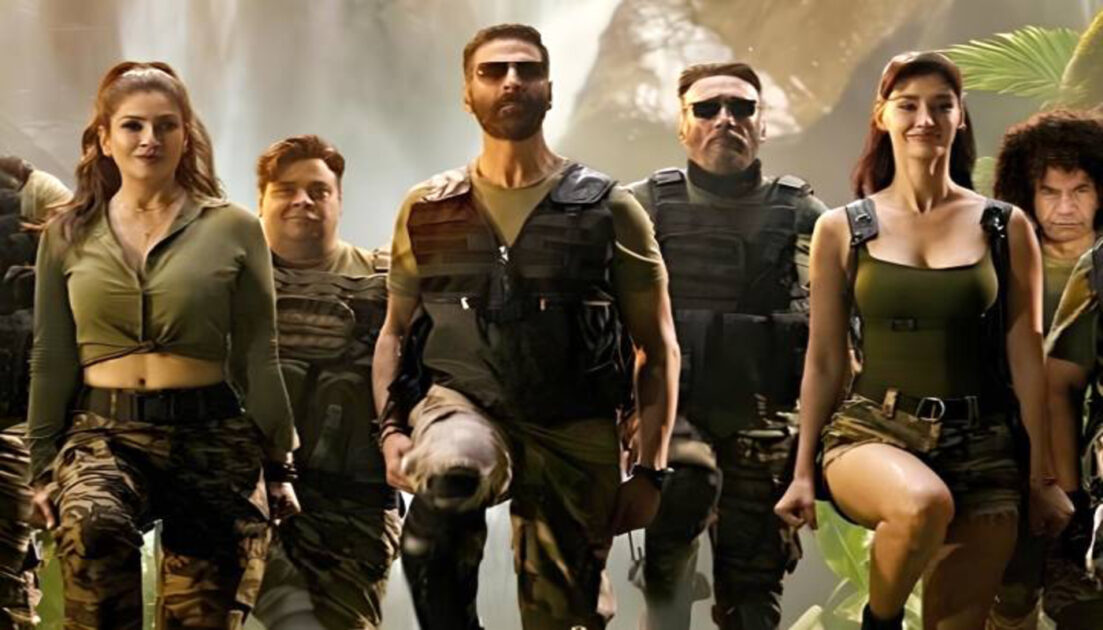
Directed by Ahmed Khan and built on the story by the late Neeraj Vora, Welcome To The Jungle brings together one of the largest ensemble casts seen in recent Hindi cinema. Featuring Akshay Kumar, Suniel Shetty, Disha Patani, Jacqueline Fernandez, Arshad Warsi, Jackie Shroff, Paresh Rawal, Raveena Tandon, Lara Dutta, Shreyas Talpade, Tusshar Kapoor and several supporting performers, the film attempts something difficult: creating order out of absolute cinematic chaos.
The result is messy, exaggerated, illogical—and surprisingly entertaining.
A Story That Turns Absurdity Into Entertainment
At its core, Welcome To The Jungle tells a story that sounds outrageous even before the first scene begins.
The film follows Sinha, a wealthy businessman who receives disturbing political advice from an insider. Faced with the possibility of imprisonment over financial irregularities if political winds shift, he is told to deliberately incur losses. His solution? Produce a giant movie destined to fail.
Instead of investing in success, he assembles a deliberately disastrous film crew.
Flop directors are hired. A struggling actor becomes the lead. Misfit technicians join the production. Financially troubled gangsters insert themselves into the cast. Additional actors continue appearing until the production resembles less of a film and more of a travelling circus.
What starts as an intentionally doomed movie project soon spirals into something much larger when the film unit travels to a remote area and unknowingly enters a region controlled by dangerous forces. Because the actors are dressed as military officers for their shoot, everyone assumes they are actual officials.
That misunderstanding becomes the foundation of the second half.
The premise itself is impossible to take seriously—and that is exactly the point.
This is not a film interested in realism. It operates on exaggerated logic where coincidence drives the narrative and absurd situations become the primary source of humour.
Ensemble Casting That Thrives on Familiar Energy
One of the film’s strongest weapons is undoubtedly its cast.
Akshay Kumar plays Rajiv Kohli, an unsuccessful actor trying to survive inside an already collapsing production. Akshay understands this territory extremely well. His comic timing remains dependable, and he contributes significantly to maintaining momentum whenever the narrative becomes overcrowded.
Suniel Shetty and Arshad Warsi bring an entertaining unpredictability as gangsters who somehow become involved in filmmaking. Their presence injects energy into scenes that could otherwise feel repetitive.
Paresh Rawal once again demonstrates why ensemble comedy remains one of his strongest genres. His delivery style and ability to remain completely serious inside ridiculous situations elevate multiple moments.
Shreyas Talpade’s character receives one of the more memorable personality quirks among the supporting cast. The film frequently relies on exaggerated individual traits, and actors like Talpade understand how to make these moments land.
Jacqueline Fernandez and Disha Patani add glamour and maintain the larger-than-life commercial atmosphere the film constantly aims for. While their character arcs are not deeply explored, they fit comfortably within the exaggerated cinematic world.
Jackie Shroff’s presence as the feared antagonist adds theatrical intensity rather than realistic menace. His scenes are designed for spectacle and performance more than fear.
What becomes clear quickly is that this is not a film of character depth.
Instead, every actor contributes to a constantly rotating comedic machine.
Ahmed Khan’s Direction Understands the Assignment
Managing a large ensemble cast is difficult.
Managing one inside an intentionally chaotic comedy-action hybrid is even harder.
Ahmed Khan deserves recognition for understanding what kind of film he is making.
The direction does not pretend to chase emotional sophistication or social realism. Instead, it embraces exaggeration and keeps the energy moving.
Films like this survive through rhythm.
Scenes need to move quickly. Characters must remain visually memorable. Humour has to arrive frequently enough that audiences overlook narrative inconsistencies.
For the most part, the direction succeeds.
The scale feels large. Locations add visual variety. Action sequences provide enough movement to avoid repetitive dialogue-driven comedy.
There is also confidence in embracing old-school Bollywood entertainment traditions.
The film does not seem overly worried about appearing “cool” or “elevated.” Instead, it welcomes slapstick, exaggerated reactions, over-the-top situations, and intentionally ridiculous character choices.
That confidence becomes one of its biggest strengths.
Comedy That Refuses to Play Safe
Perhaps the most interesting aspect of Welcome To The Jungle is its comedic approach.
Modern comedy films often become cautious.
Writers frequently soften jokes to avoid criticism or create humour that feels universally acceptable.
This film takes a different route.
Its humour occasionally becomes loud, politically incorrect, exaggerated, and intentionally silly.
Not every joke works.
Some sequences feel stretched.
Some comedic setups depend heavily on familiar Bollywood tropes.
Yet there is also a refreshing unpredictability because the film is willing to attempt jokes that contemporary commercial cinema increasingly avoids.
Viewers who enjoy broad theatrical comedy may find themselves laughing more than expected.
Those looking for subtle satire or sophisticated writing may not connect in the same way.
The film understands its audience and rarely pretends to be something else.
Where the Film Begins to Lose Momentum
Despite its entertainment value, Welcome To The Jungle is not without problems.
The first noticeable issue is excess.
Too many characters enter the story.
Several contribute little beyond occupying screen space.
At times, scenes resemble celebrity appearances rather than narrative progression.
A tighter screenplay could have improved pacing significantly.
Certain emotional tracks feel underdeveloped and interrupt the comic rhythm.
There are moments where the film appears unsure whether to become emotional, adventurous, or continue leaning fully into absurd comedy.
Some story parallels may also feel familiar to experienced viewers.
A few sequences trigger memories of earlier Bollywood narratives, making portions feel less original than the setup initially suggests.
Additionally, viewers expecting logical progression may struggle.
The film asks audiences to suspend disbelief repeatedly.
Once you accept that logic does not exist in this world, the experience becomes considerably smoother.
Another element that deserves appreciation is the film’s visual ambition. Ensemble entertainers often become visually cluttered because of too many actors competing for screen space, but Welcome To The Jungle attempts to maintain a cinematic scale throughout. The hilly landscapes, large action setups, colourful costumes, and busy production design contribute to the exaggerated world-building. While not every frame appears polished, the visual energy helps sustain audience engagement. The locations especially become important in the latter half, creating a contrast between the absurd comedy and the unexpectedly high-stakes environment surrounding the characters.
The soundtrack and background score also play an important role in shaping the viewing experience. Rather than functioning as standalone musical highlights, the songs operate as extensions of the film’s energetic personality. The background music frequently amplifies comedic beats, dramatic entrances, and over-the-top action moments. This approach supports the exaggerated storytelling style and ensures scenes rarely feel static. While the album may not produce timeless chartbusters, it effectively complements the atmosphere of a mass entertainer. In theatres especially, these moments are likely to generate stronger audience reactions and collective enjoyment.
What makes the film particularly interesting is how unapologetically old-school it feels. Contemporary Bollywood often experiments with realism, darker tones, or socially aware narratives, but Welcome To The Jungle embraces the formula of chaos, coincidence, exaggerated misunderstandings, and larger-than-life performances. In many ways, it feels like a throwback to an era when audiences entered theatres expecting escapism above all else. That nostalgic quality may become one of its biggest strengths because viewers familiar with commercial entertainers could find comfort in its intentionally excessive style.
Ultimately, Welcome To The Jungle succeeds not because it is flawless but because it understands entertainment value. It does not chase awards, critical prestige, or emotional complexity. Instead, it focuses on delivering spectacle, humour, and moments that invite cheering and laughter. The film occasionally overstays certain jokes and struggles under the weight of its own cast size, yet its commitment to fun remains consistent. For audiences willing to switch off logic and embrace cinematic madness, this film offers an experience that feels energetic, chaotic, and undeniably theatrical.
Final Verdict: Big, Loud and Surprisingly Fun
Welcome To The Jungle is not cinema designed for quiet reflection.
It is designed for packed theatres, group laughter, whistles, exaggerated reactions, and collective entertainment.
Its story is outrageous.
Its humour is uneven.
Its character count borders on excessive.
And yet, somewhere inside all the madness, the film delivers exactly what it promises.
There is nostalgia in watching unapologetically commercial Hindi entertainment embrace its identity instead of apologising for it.
The movie will not appeal equally to everyone.
Viewers who prefer grounded storytelling may find the experience exhausting.
But audiences looking for escapism, ensemble comedy, action, and old-school Bollywood energy are likely to leave satisfied.
Sometimes entertainment does not need precision.
Sometimes it only needs commitment.
Welcome To The Jungle commits fully to its chaos—and that is what makes it work.