 by
by Prime Video’s The Traitors Season 2 has already delivered plenty of drama, unexpected eliminations, heated discussions and shifting alliances. While the main episodes have focused on the central battle between the Traitors and Innocents, newly released deleted scenes have given viewers a glimpse into several conversations that did not make it into the televised episodes.
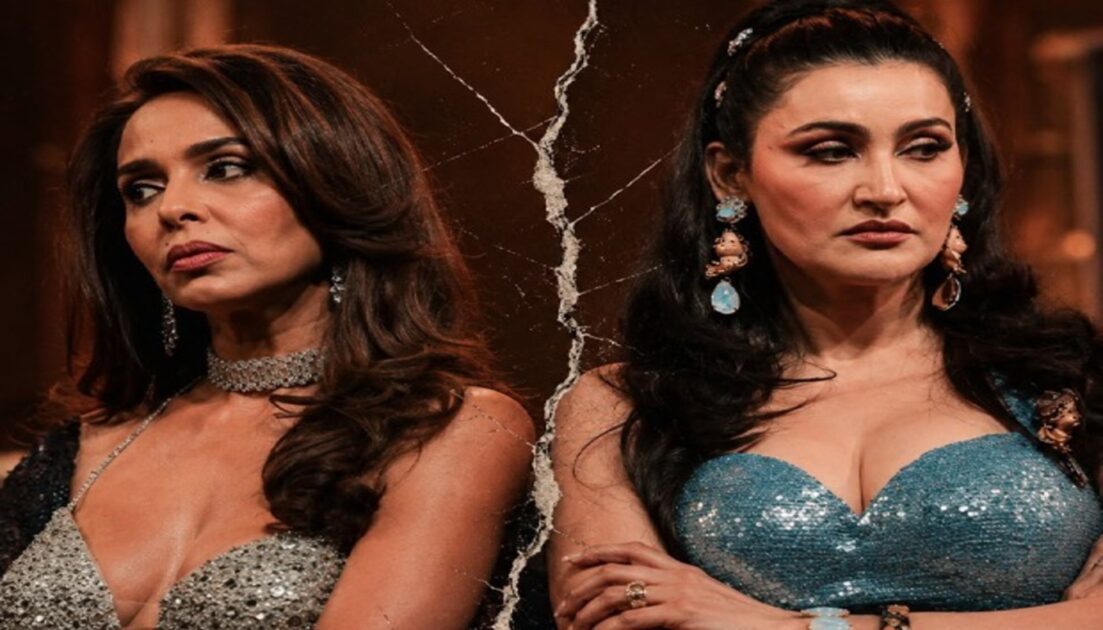
The unseen footage features two particularly interesting moments. One involves Shalini Passi questioning Mallika Sherawat’s claim about wearing a Dolce & Gabbana outfit, while another gives viewers more insight into Munawar Faruqui’s reaction following his elimination. Munawar also takes apparent digs at Abhishek Malhan and Harman Singha, adding another layer to the tensions that surrounded his early exit.
Shalini Passi Questions Mallika Sherawat’s Dolce & Gabbana Claim
The fashion-related exchange between Shalini Passi and Mallika Sherawat has quickly become one of the more talked-about deleted moments. Mallika is seen discussing her green shimmering dress and identifying it as a Dolce & Gabbana creation.
At first, the conversation appears to be a casual discussion about fashion. However, Shalini soon questions Mallika’s claim. Sitting with other contestants, including Shweta Tiwari, Rida Tharana and Rhea Chakraborty, Shalini reportedly expressed doubts about the outfit and suggested that it did not look like an authentic Dolce & Gabbana piece based on her knowledge of the brand.
Shalini’s confidence in making the observation comes from her well-known interest in luxury fashion. During the conversation, she referred to her own experience with designer clothing and spoke about wearing custom-made pieces from prominent fashion houses.
The exchange became entertaining because of the contrasting personalities involved. Mallika has always maintained a glamorous and distinctive public image, while Shalini is known for being outspoken and direct about her interests, particularly when it comes to art, fashion and luxury.
Rather than simply complimenting the dress or moving on from the conversation, Shalini appeared determined to make her opinion known.
However, it is important to distinguish between an allegation and an established fact. Shalini’s comments in the deleted footage represent her own claim about the dress. The scene itself does not independently establish that Mallika was actually wearing a counterfeit Dolce & Gabbana outfit.
The controversy nevertheless added another entertaining layer to the show. Reality television often turns seemingly ordinary conversations into memorable moments, especially when strong personalities disagree.
Shalini’s Fashion Knowledge Becomes Part of the Drama
Shalini’s comments also gave viewers another glimpse into the way she approaches conversations inside the Traitors’ mansion. She appears comfortable expressing her opinions, even when doing so could potentially create tension with another celebrity.
The moment is particularly interesting because Shalini did not merely question the dress casually. She reportedly backed up her opinion by referring to her familiarity with luxury fashion and her experience with designer clothing.
That confidence gave the conversation an almost competitive quality.
The scene also demonstrates why deleted footage can sometimes change the way audiences perceive reality-show relationships. A broadcast episode has to condense hours of footage into a manageable storyline. As a result, smaller conversations, jokes and disagreements can disappear even though they reveal important details about the contestants.
In this case, the deleted scene provides another example of Shalini’s outspoken personality. She does not appear particularly hesitant about expressing her opinion, even when doing so involves another well-known celebrity.
Mallika, meanwhile, has emerged as one of the more distinctive personalities of the season. Her presence brings glamour and unpredictability to a house where almost every interaction can potentially influence the game.
The fashion conversation therefore becomes more than a discussion about a dress. It is another glimpse into how strong personalities can collide inside The Traitors environment.
The “Dol Chee” Moment Adds a Humorous Twist
The scene also attracted attention because of the playful way Shalini reportedly referred to the luxury label. Her pronunciation of Dolce as “Dol Chee” added a humorous element to her skepticism.
That small moment helped turn what could have been a minor fashion discussion into a memorable reality-TV exchange.
Reality television often thrives on these unscripted interactions. The main competition may revolve around identifying hidden Traitors, but audiences also become invested in personalities, friendships, rivalries and humorous disagreements.
The Mallika-Shalini interaction is a perfect example.
It is dramatic without being directly connected to the murder or banishment mechanics of the game. Yet it provides entertainment and gives viewers another reason to discuss the contestants outside the central mystery.
Munawar Faruqui’s Deleted Scene Reveals a More Emotional Side
The second major deleted scene has a very different tone.
Munawar Faruqui’s unexpected elimination was one of the biggest talking points from the opening phase of The Traitors Season 2. The comedian entered the competition with considerable reality-show experience and was widely expected to be a formidable player.
Instead, he became an early casualty.
Munawar was identified as an Innocent and eliminated during the Circle of Shaq after contestants began questioning his intentions and gameplay. Abhishek Malhan and Harman Singha were among the players who challenged Munawar’s approach, making the discussion surrounding his elimination particularly significant.
The deleted footage gives audiences a closer look at Munawar’s feelings after the vote.
Instead of simply treating his departure as an ordinary part of the competition, Munawar suggested that the contestants had become more interested in eliminating him than actually finding the Traitors.
His reaction indicates that he believed personal perceptions and insecurity had influenced the decision.
From Munawar’s perspective, his reputation may have worked against him. Entering a deception-based reality show with a history of winning other reality competitions can make a contestant look dangerous even before they have established themselves in the new game.
That creates an interesting paradox.
A strong reputation can make someone valuable to a team, but it can also make that person an immediate target.
Munawar’s elimination therefore becomes an example of how quickly a contestant’s previous achievements can influence the way others perceive them.
Munawar and Abhishek’s Rivalry Intensifies
The disagreement between Munawar and Abhishek Malhan did not end with the elimination.
Instead, the tension spilled beyond the show.
Munawar made remarks that were interpreted as digs at Abhishek and the alliance-based approach to the competition. He suggested that contestants who wanted to win through teamwork and alliances could simply join an alliance, implying that the game should involve more individual strategic thinking.
The comments added fuel to an already developing rivalry.
Abhishek also responded to Munawar’s remarks, keeping the disagreement alive even after Munawar’s departure from the competition.
For viewers, the clash is interesting because both contestants appeared convinced that their understanding of the game was stronger.
In The Traitors, however, there is no single guaranteed winning strategy. Alliances can protect a contestant, but they can also make that player look suspicious. Playing independently can demonstrate confidence, but it can also isolate a contestant from the rest of the group.
Munawar’s elimination demonstrates exactly how dangerous that balance can be.
The conflict also highlights one of the biggest questions surrounding the show: should contestants trust their own instincts or follow the majority?
In a game where information is deliberately limited, both approaches can succeed or fail.
Harman Singha Becomes an Important Part of the Munawar Story
Harman Singha’s role in the story makes Munawar’s elimination even more interesting in retrospect.
Harman was among the contestants who questioned Munawar’s intentions. However, Harman was later revealed to be a genuine Traitor.
That revelation significantly changes the context surrounding the earlier discussions.
Munawar was an Innocent who was suspected of being a Traitor, while Harman was actually hiding the secret role that the contestants were supposed to identify.
This is precisely what makes The Traitors format so unpredictable.
The contestants do not have complete information. They must rely on conversations, behaviour, instincts and relationships to decide whom they can trust.
A person who appears suspicious may be completely innocent, while a genuine Traitor can deliberately encourage suspicion around someone else.
Munawar’s frustration therefore becomes an interesting part of the larger strategic narrative.
His argument was not simply that he had been eliminated. He believed that the contestants had failed to identify the actual threat and instead allowed their personal perceptions to guide the vote.
Why Munawar’s Elimination Was Such a Major Shock
Munawar’s early exit was particularly surprising because of the experience he brought into the competition.
Before entering The Traitors Season 2, he had already demonstrated an ability to handle pressure and navigate competitive reality television. That naturally made him one of the contestants viewers expected to survive for longer.
Instead, his reputation may have made him an obvious target.
When several contestants begin suspecting the same person, it can become increasingly difficult for that individual to defend themselves. Every explanation can be interpreted as another attempt to manipulate the group.
That is one of the most important psychological elements of The Traitors.
The contestants are not working with certainty. They are making decisions based on incomplete information.
As a result, confidence can look like deception, intelligence can look like manipulation and nervousness can look like guilt.
Munawar’s situation perfectly demonstrates this problem.
His previous success may have made the other contestants wary of allowing him to progress too far into the competition.
The irony is that removing a strong Innocent can ultimately benefit the real Traitors.
Deleted Scenes Change the Picture of the Main Episodes
The release of deleted scenes is valuable because the audience gets to see events that might otherwise remain unknown.
Reality shows are heavily edited. Producers have to select which conversations advance the central storyline, which reactions are essential and which moments can be removed for pacing.
But deleted footage can reveal what happened between the major scenes.
In The Traitors Season 2, that additional footage is particularly useful because the opening episodes move rapidly between challenges, suspicions, alliances, eliminations and revelations.
The Mallika-Shalini conversation shows the lighter, personality-driven side of the house.
Munawar’s elimination reaction, on the other hand, reveals the emotional consequences of the game’s strategic decisions.
Together, they present two very different forms of drama.
One revolves around fashion, celebrity personalities and a disputed designer claim. The other revolves around trust, betrayal, insecurity and the fundamental question of whether the players were correctly identifying the enemy.
The Traitors’ Biggest Weapon May Be Distrust
At its core, The Traitors is not simply about lying.
It is about creating an environment in which nobody can confidently determine who is telling the truth.
The Munawar situation illustrates this perfectly. His reputation made him suspicious. His confidence could be interpreted as overconfidence. His conversations could be viewed as strategic manipulation.
Once enough contestants reached that conclusion, it became difficult for him to reverse their perception.
Meanwhile, the actual Traitors benefited from the confusion.
This is also why the deleted scenes matter. They show that there is often more happening in the house than what reaches the main episode.
A short conversation can influence someone’s opinion. A private comment can shape an alliance. A seemingly insignificant disagreement can later become relevant to a vote.
The audience only sees the final edited version.
The deleted footage offers another piece of the puzzle.
Shalini and Munawar Represent Two Different Sides of the Show
Interestingly, the two deleted scenes highlight completely different elements of The Traitors.
Shalini Passi and Mallika Sherawat’s exchange represents the celebrity and entertainment side of the show. It is glamorous, humorous and personality-driven.
Munawar’s scene represents the psychological side.
His frustration focuses on why people make certain decisions and whether those decisions are genuinely based on evidence or influenced by insecurity, reputation and group dynamics.
That contrast is part of what makes the series compelling.
It can move from a conversation about designer fashion to a serious confrontation over trust within minutes.
The contestants are not simply participating in a competition. They are also creating a social environment where every interaction can influence future decisions.
Early Eliminations Have Already Reshaped the Game
The opening stretch of the season has already been packed with departures and revelations.
Dalip Tahil, Sondous Moufakir, Munawar Faruqui and Harman Singha have all exited the competition, leaving the remaining contestants to navigate an increasingly uncertain game.
Harman’s elimination was especially significant because his identity as a Traitor was exposed, giving the Innocents an important strategic victory.
Munawar’s elimination, on the other hand, represented a strategic setback because an Innocent was removed while a genuine Traitor remained in the game.
That difference highlights the central danger facing the contestants.
Every incorrect accusation gives the Traitors an advantage.
The more the Innocents become divided, the easier it becomes for the hidden players to manipulate the group.
The deleted footage therefore adds more context to one of the most important themes of the season: distrust.
What These Deleted Scenes Add to Season 2
The newly released footage does not necessarily change the outcome of the competition, but it adds valuable context.
Shalini’s comments about Mallika’s dress offer another glimpse into the outspoken personality she has brought into the competition. The scene has created buzz because of the seriousness with which she questioned the designer claim, although the allegation remains Shalini’s claim rather than independently verified evidence that the outfit was counterfeit.
Munawar’s deleted footage, meanwhile, deepens the understanding of his reaction to elimination. It shows that his frustration was not merely about losing. He believed the contestants had allowed personal insecurity and group dynamics to influence their decision.
His subsequent disagreement with Abhishek ensured that the rivalry continued even after Munawar left the competition.
Harman’s exposure as a genuine Traitor adds an ironic dimension to Munawar’s complaints.
The player who was suspected by many was innocent, while someone who was genuinely hiding a secret role managed to survive the scrutiny for a time.
Final Thoughts
The Traitors Season 2 is proving that the most interesting moments are not always the ones that make the final episode.
The newly released deleted scenes reveal conversations that add depth to the show’s already complicated relationships. Shalini Passi’s questioning of Mallika Sherawat’s Dolce & Gabbana claim has created a playful but controversial fashion-related clash, while Munawar Faruqui’s emotional elimination footage provides a more revealing look at the tensions surrounding his early departure.
The Munawar-Abhishek conflict, in particular, demonstrates how quickly competition can become personal when contestants believe their reputations and strategies are being challenged. His comments about alliances and insecurity, followed by Abhishek’s response, show that the rivalry did not necessarily end when Munawar left the game.
At the same time, Harman Singha’s exposure as a Traitor makes the early accusations surrounding Munawar even more fascinating. The player who was suspected was innocent, while someone who was genuinely hiding a secret role managed to remain under the radar.
That is the central attraction of The Traitors: appearances are rarely enough.
Whether it is a designer label, a friendship, an alliance or a suspicious conversation, nothing can be taken entirely at face value. The deleted scenes simply provide audiences with more pieces to a puzzle in which every contestant is trying to determine who can be trusted and who cannot.
With the season still unfolding, these unseen moments suggest that there may be plenty more drama hiding behind the scenes. And if the opening episodes are any indication, the biggest surprises of The Traitors Season 2 may still be ahead.